
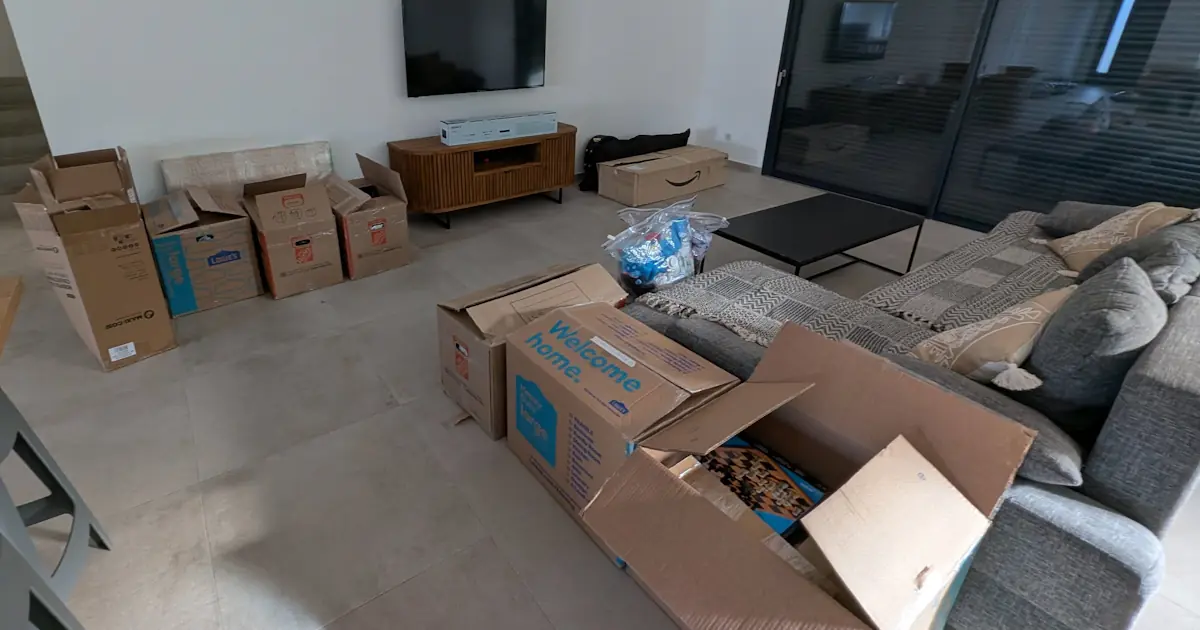
Most people treat shipping belongings to France as one booking. That is the expensive mistake. You still need beds and kitchen gear in week one, while sea freight often takes weeks after port handling. Before you pick a mover, split three tracks: what must arrive in about 10 days (luggage or a courier), what can ride sea freight for the first season, and what is cheaper to buy in France than to ship.
Quick answer: From the US, sea freight (shared LCL or full FCL container) is the usual choice for furniture and boxes above a few cubic meters. Book about 10 to 12 weeks before your target delivery in summer, and treat the arrival date as a range. Use airline bags or a door-to-door luggage courier (for example SendMyBag-class) for bridge gear. Confirm transfer-of-residence customs rules on Service-Public F492 with your mover. See the declutter guide for what to cut before you measure volume.
Pairs with the moving to France hub, renting in France, and France visa options.
Three tracks for shipping belongings to France
Track A (week one): checked bags you control, plus courier boxes for cot gear, sheets, coats, or kitchen basics that would blow airline weight caps. Track B (first season): sea LCL or FCL for what you truly need and cannot replace easily. Track C (skip list): IKEA, Le Bon Coin, and EU-voltage appliances after you have keys.
If you book a full container for everything and still pay overweight on four suitcases, you often pay twice. If you send only luggage and wait six weeks for the container while living unfurnished, you often pay in hotels and emergency furniture. Unfurnished vs furnished leases change this math — see renting in France.
Luggage courier vs airline bags vs sea freight
| Option | Best for | Watch-outs |
|---|---|---|
| Airline checked bags | What you need on landing day | Weight caps; CDG haul with kids is hard |
| Luggage courier (SendMyBag-class) | Bridge boxes under weight/size limits (~2 weeks) | Not furniture; delivery needs a receiver; lighter customs than household relief |
| Sea LCL (shared container) | Partial household if you can wait | Often ~8–14 weeks door-to-door with port handling |
| Sea FCL (full container) | Full house, one sealable unit | Higher cost; still need week-one gear |
| Air freight | Tiny urgent batches | Usually not worth it for household volume unless work pays |
Community reports often put courier boxes roughly in the $150–$300 range each (weight and corridor matter) versus roughly $100–$200 per extra airline bag one-way — verify live quotes. Couriers are the wrong tool for a dining table or a full transfer-of-residence inventory. Keep courier contents coherent with your sea inventory so declarations do not conflict.
Sea freight from the US: LCL, FCL, and timing
From the US mainland, sea is the default for anything above about 2 m³ you truly need. LCL saves money if you can tolerate shared space and longer ranges. FCL fits a full house. Road freight mainly helps if you are already in Europe — not the typical US origin path.
Orientation only (verify with movers): US East Coast LCL for a partial household is often quoted roughly $2,500–$6,000, highly volume-dependent; full containers cost more. Ocean transit plus French port and inland delivery commonly lands in a multi-week range; summer peaks often add delay. Book sea 10–12 weeks before desired delivery in peak season. Do not set your lease start as the guaranteed delivery day.
French city access changes quotes. Narrow streets, no elevator, long stair carries, and parking bans often add fees or force warehouse pickup. “Door-to-door” may mean the truck reaches a nearby street, not your fifth-floor salon.
What never goes in the container
Keep with you: passports, visa papers, medication, jewelry, work laptops, and at least one week of clothes for the season you land in. Carry PDF copies of inventory, lease, and insurance. Shipping legal originals (birth certificates, titles) in freight leaves you empty-handed if customs asks at arrival.
Skip shipping most heavy 110V kitchen gear. Adapters do not fix voltage. Many French apartments and insurers expect EU appliances anyway — see the decluttering before moving abroad cut for sell/store/ship decisions.
Customs for household goods (orientation)
Used furniture is not automatic duty-free. For many non-EU transfers of main residence, France offers relief under transfer-of-residence rules when conditions are met (prior residence outside the EU, personal use, timing, inventory). Confirm current rules on Service-Public F492 and with your mover. Alcohol, tobacco, and many commercial items are usually excluded.
Build one coherent valued inventory for the sea shipment. Do not assume courier boxes alone can carry your full household relief claim. This is orientation only, not legal advice.
First 48 hours if freight is still weeks out
If you land on a weekend with an unfurnished walk-up and the container is still weeks away, next-day French retail may be blocked until you have a local phone or delivery address. Plan bridge gear (sheets, basic cookware, child items) to arrive before or with you, and confirm who can receive packages. Extending hotels and buying emergency furniture can cost more than a couple of courier boxes.
Common mistakes
- Booking one shipper before splitting week-one, season-one, and buy-in-France lists
- Treating courier boxes as a full-house substitute
- Assuming door-to-door means your apartment door
- Shipping voltage-wrong appliances “just in case”
- Letting freight arrive before you have keys or a delivery address
- Mixing inconsistent inventories across courier and sea channels
FAQ
How long does shipping belongings to France from the US take?
Sea door-to-door often lands in a multi-week range once you include port handling and inland delivery. Plan buffers; summer is slower. Ask each mover for a range, not a single date.
SendMyBag vs extra airline bags — which is cheaper?
Compare live quotes. Couriers can beat overweight fees when you have several heavy boxes, and they skip the airport carousel. Airline bags win when you need items the hour you land and stay under allowance.
LCL vs FCL for a two-bedroom apartment?
Many partial households fit LCL if volume is modest and timing is flexible. FCL makes more sense when volume approaches a full container and you want one sealed unit. Get volume measured before you choose.
Can I claim duty-free household goods and still use courier boxes?
Couriers can bridge personal effects, but full transfer-of-residence relief usually rides on a proper household shipment and inventory. Keep channels consistent and check F492 plus your mover.
What if my shipment arrives before my lease starts?
You may need temporary storage or a delayed delivery window. Align freight with keys, not only with your flight date.
Should I ship US mattresses and appliances?
Often no. Sizes and voltage differ, and French access can block bulky pieces. Rebuying after arrival frequently costs less overall.
How Relocora keeps shipping on the same timeline
Relocora does not book freight or clear customs. It places logistics tasks beside visa and housing on your checklist so delivery dates follow keys and paperwork. Store mover quotes, inventories, and contracts in the Document Vault. Ask the AI Coach which step comes first (information only).
Getting the three tracks right will not make the move light. It usually means fewer surprise hotel nights and fewer cubic meters you never needed.